Liquidity Hunts & Sentiment Traps: Why Smart Money Moves Before the Crowd
The most expensive lesson in trading is realizing that price often moves in the exact opposite direction of the news. You see a bullish headline, you buy, and the market immediately reverses. This isn't bad luck. It is market efficiency in action.
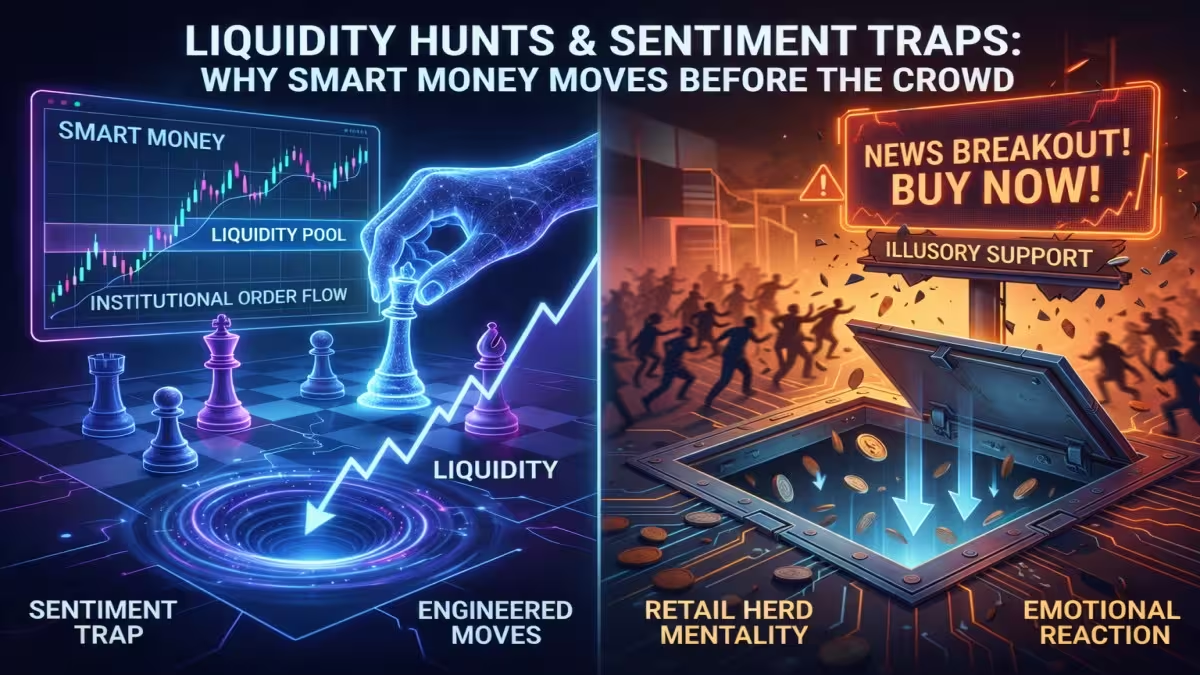
Institutions operate on a different set of rules than retail traders. While retail looks for "reasons" (news, rumors), smart money looks for "locations" (liquidity). They need depth to fill large orders without slipping the price, and that depth is usually found where the crowd places their protective stops.
Understanding this dynamic requires a shift in mindset. You must stop trading what you "feel" and start trading what the structure demands. This is the cornerstone of advanced crypto trading psychology and risk management—recognizing that the market is an engineered environment, not a random one.
The Mechanics of the Hunt
Let’s look at the math, not the emotion. If a fund needs to buy a substantial amount of an asset, they cannot simply buy at market price. Doing so would exhaust the order book and drive the average entry price up significantly.
They require a surge of selling pressure to absorb their buy orders.
Where does this selling pressure come from? It sits just below obvious support levels. When price breaches these levels, two things happen simultaneously: breakout traders enter short, and long traders hit their stop losses. Both actions generate sell orders. This provides the exact liquidity the institution needs to fill their buy positions. We often see this manifest as rapid wicks or liquidity cascades, which terrify retail but signal opportunity to professionals.
Key Observation:
If a support level is too clean and too obvious, it is rarely a floor. It is a target.
Sentiment as a Contrarian Indicator
Human emotion is predictable. At market tops, euphoria blinds participants to risk. At market bottoms, fear blinds them to opportunity.
Institutional algorithms monitor these sentiment extremes closely. When metrics like funding rates or social volume hit peak levels, it signals that the trend is overcrowded. We analyzed this phenomenon deeply in our report on Solana liquidity reflexivity, demonstrating how social hype often marks the precise moment of distribution.
When everyone who wants to buy has already bought, who is left to push the price higher? No one. The path of least resistance flips downward.
The Low-Volume Anomaly
Liquidity hunts are most prevalent when the order books are thin. Weekends and holidays create a unique environment where lower capital is required to move price to a specific level.
It is common to see a "fake breakout" occur during these low-volume windows, trapping eager traders before the major desks return on Monday to reverse the move. This cyclical behavior is critical to understand if you are navigating a DeFi market cycle during holidays. The price action is real, but the intent is often deceptive.
The News Lag
Why does "good news" often lead to a sell-off? Because smart money positions itself during the risk-on accumulation phase, long before the headlines are written.
By the time the news hits the wire, the move is mathematically complete. The news event simply provides the volume (via retail excitement) for early investors to exit their positions. This is capital rotation 101.
Structuring Your Defense
You cannot beat the speed of an algorithm, but you can exploit its predictability.
- Wait for the Sweep: Do not front-run a level. Wait for the liquidity grab to occur and for price to reclaim the range.
- Analyze Open Interest: A price rise accompanied by falling Open Interest indicates short-covering, not organic buying. This is weak structure.
- Protect Capital First: Strategy is useless if your assets are vulnerable. Ensure your operational security is flawless by following a crypto security survival guide.
Final Thoughts
The market is an efficiency machine designed to transfer wealth from the reactive to the prepared. By ignoring the noise of sentiment and focusing on the mechanics of liquidity, you align yourself with the flow of capital rather than fighting against it.