Lens Protocol Architecture: Why "Momoka" Speed and Polygon Security Created the First True SocialFi Economy
In the evolving landscape of Web3 social media, few innovations are as critical yet misunderstood as Lens Protocol. While the retail market focuses on the frontend applications, the true technical revolution lies in its underlying "Social Graph" architecture. It is not merely a social network; it is a decentralized ownership layer that allows creators to decouple their digital roots from any single platform.
For many creators, the confusion stems from a simple question: "Why do I need a blockchain to post a photo?" The answer isn't about storage; it's about portability.
This article provides a technical breakdown of the Lens ecosystem, specifically analyzing how the dual-layer network (Polygon & Momoka) solves the scalability trilemma, and why earning in stable USDT on this protocol is becoming the gold standard for digital monetization.
The Structural Shift: From "Tenant" to "Landlord"
To understand Lens, we must first diagnose the flaw of Web2. On traditional platforms like X or Instagram, you are a "digital tenant." If you leave the platform, your audience stays behind. Lens Protocol changes this paradigm by tokenizing your profile into an NFT.
Decoding the Architecture: The Two-Layer Solution
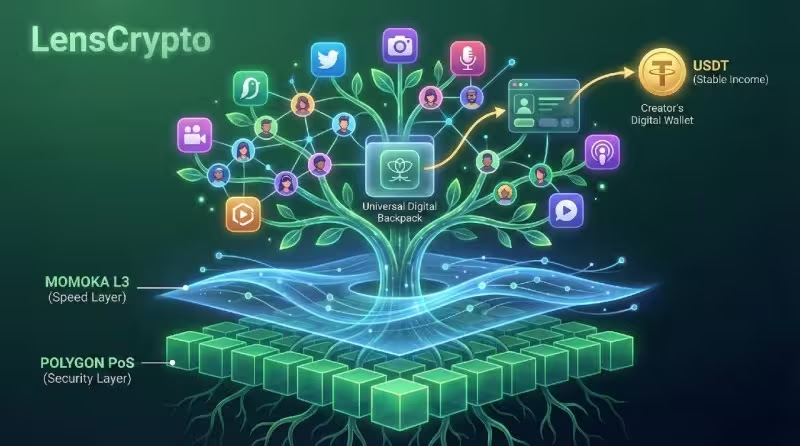
Just as USDT utilizes specific networks for different use cases (Speed vs. Security), Lens Protocol employs a sophisticated hybrid architecture to balance social velocity with financial security. It splits the workload into two distinct lanes:
1. The Foundation: Polygon (PoS)
Lens is anchored on the Polygon Proof-of-Stake blockchain. This serves as the "Vault" of the ecosystem.
- The Function: Permanent ownership. When you mint a Profile NFT, purchase a "Collect," or execute a high-value transaction, it is recorded here.
- The Logic: Polygon was chosen over Ethereum mainnet to minimize the carbon footprint and gas fees, while maintaining EVM compatibility for seamless wallet integration.
2. The Velocity Layer: Momoka (Optimistic L3)
This is the secret weapon that solves the "Blockchain Scalability Trilemma" for social media. Momoka is an Optimistic Layer 3 solution designed specifically for high-frequency actions.
- The Problem: Putting every "Like" and "Share" on a blockchain is expensive and slow.
- The Momoka Solution: It processes these interactions off-chain and verifies them in batches (data availability). This allows Lens to feel as snappy as a Web2 app while ensuring the data remains verifiable and decentralized.
The Economics: Why USDT is the "King Coin" on Lens
Newcomers often ask why creators on Lens prefer pricing their content in USDT (Tether) rather than volatile meme coins or native governance tokens. The answer lies in the "Collect Module" mechanics.
On Lens, fans can "collect" (purchase) your content as digital memorabilia. Smart creators price these collects in USDT on the Polygon network because:
- Predictable Income: Earning 10 USDT guarantees $10 of real-world purchasing power. This stability is crucial for creators who treat Web3 as a job, not a casino.
- Micro-Transaction Efficiency: Sending USDT on Polygon costs fractions of a cent. This makes it economically viable for fans to tip small amounts ($1 or $2) without losing 50% of the value to network gas fees.
Risk & Limitations: The Privacy Trade-Off
While the architecture is robust, it is not without risks that every user must acknowledge.
Furthermore, while Momoka is revolutionary, it relies on Data Availability layers. If the underlying storage nodes were to fail catastrophically, the "history" of likes/mirrors could theoretically be compromised, although the core assets (Profiles/NFTs) would remain safe on Polygon.
Interpretation: The Verdict on SocialFi
Navigating the transition from Web2 to Web3 requires understanding infrastructure. For developers and creators tired of platform risk, Lens Protocol offers the most robust architecture currently available.
By combining the security of Polygon with the speed of Momoka, Lens has successfully built a "Digital Garden" where users can finally cultivate an audience they actually own.